How to Get Out of a Chair After a C-Section (Without Hurting Your Incision)
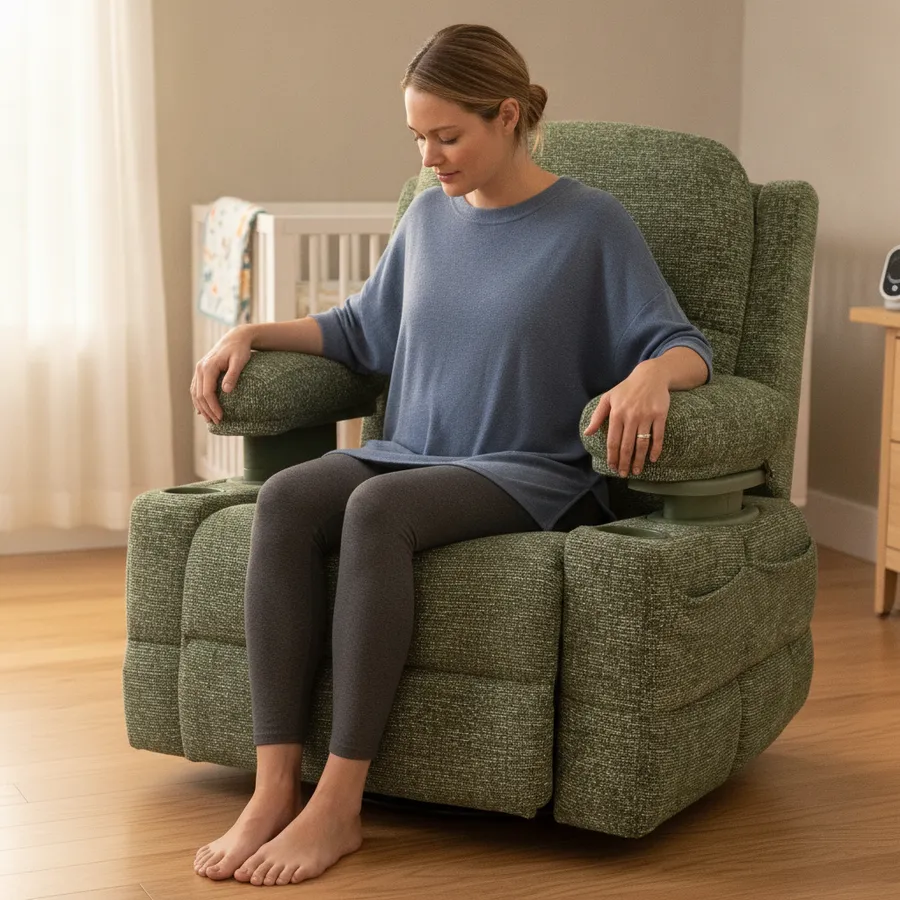
AI-generated representative image — not an actual photo of a real patient or event.
If you've caught yourself bracing for the moment you have to stand up, you're not imagining it — for several weeks after a C-section, the ordinary act of pushing yourself out of a chair uses exactly the muscles you're not supposed to engage.
Why standing up feels so much harder right now
A C-section is abdominal surgery. For roughly 4-6 weeks afterward, your care team will generally tell you to avoid engaging your abs directly — no sit-ups, obviously, but also no bracing your core the way you normally would without thinking about it. The problem is that "push yourself up out of a low chair" is almost exactly that motion, especially one-handed, while holding a baby.
That's why something that felt effortless before surgery — getting out of your favorite reading chair, or the glider you had before baby arrived — can suddenly feel like the hardest part of your day.
The log-roll method: getting up from lying down
This is widely taught in postpartum recovery and worth knowing before you need it:
- Bend your knees and roll onto your side (not straight up from your back).
- Use your arm to push your upper body up while you swing your legs off the bed.
- Let your legs do the work of counterbalancing, not your stomach.
The same logic carries over to a chair: let your arms and legs do the work, and try not to think of your midsection as the thing doing the lifting.
Getting out of a chair, step by step
- Scoot to the edge of the seat first. Trying to stand from deep in the seat forces you to lean forward from your core to get your weight over your feet.
- Push up through your legs and arms — hands on the armrests or your thighs, not your stomach.
- Avoid twisting at the waist on the way up or down. Turn your whole body, not just your torso.
- Have someone nearby for the first couple of weeks, especially if you're also holding the baby. Handing the baby off before you stand isn't a failure — several parents told us it's exactly what worked for them.
- Be extra cautious with a chair that swivels or reclines. Standing up while the base is still moving makes it harder to find a stable base to push from — let the motion fully stop first.
Get the free C-Section Nursery Recovery Checklist
A one-page printable checklist for setting up your chair zone before baby arrives — everything within reach, so you're not the one getting up and down all day.
Free, one-page PDF. No spam — just this checklist and occasional honest nursery-chair advice.
Why chair choice actually matters here
We reviewed a power recliner (the MAMAZING Lullapod) specifically because a handful of its 285 reviewers mentioned C-section recovery unprompted — and what they said wasn't uniformly positive, which is exactly why it's worth reading before you buy anything.
"The seat is really low to the ground which will work excellent for having a C-section like I am."
"Now I am post c-section and it is kinda hard because it does sit a little low. I have to hand off baby to husband before trying to stand up."
Both are real, verified reviews of the same chair. The honest takeaway: a powered recline that moves the backrest and footrest for you genuinely helps, because you're not manually pressing a glider mechanism into place — but no chair makes standing up completely effortless in the first couple of weeks. Seat height and how freely the base swivels matter just as much as whether the recline is electric.
If you're chair shopping for recovery, here's what we found
Our full review covers the real trade-offs — including the parts other review sites don't mention — plus current pricing.
Read the Full Chair Review →A few honest answers
How long until getting up feels normal again?
This varies a lot by person and by how your specific recovery goes — most general postpartum guidance points to a gradual improvement over the first 4-6 weeks, but always follow what your own surgeon tells you at your follow-up appointments rather than a timeline from an article.
What if standing up still hurts a lot, or feels wrong?
Contact your care team. Increasing pain, fever, redness or discharge at the incision, or heavy bleeding are all reasons to call rather than wait it out — see the free checklist above for the full list we'd want any new parent to keep handy.
Do I need a new chair, or will my current one work?
Not necessarily a new one — a firm, higher seat that doesn't require you to push up from a deep recline is the main thing to look for, whether that's a chair you already own or one you're considering buying.